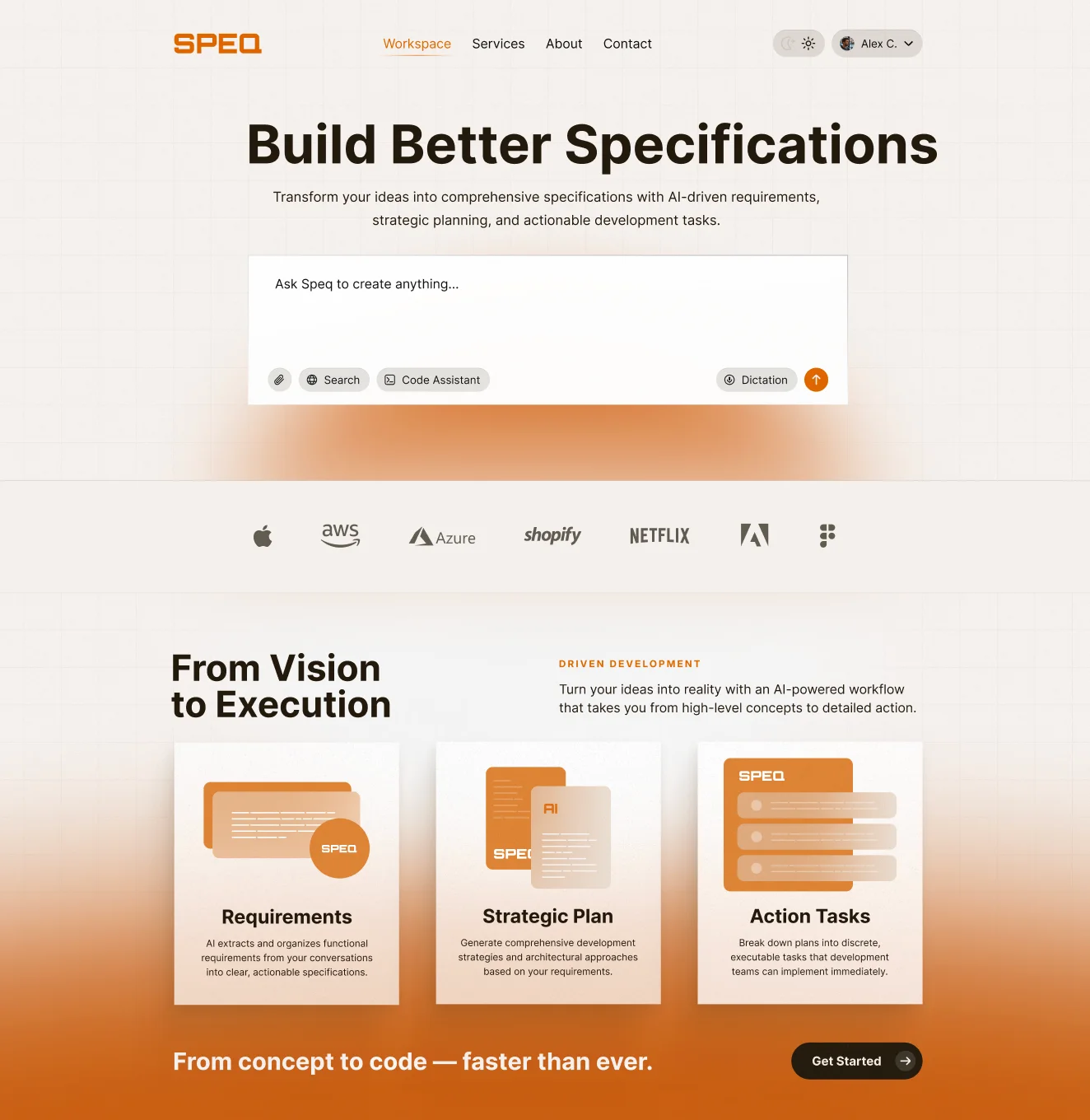
Transform your ideas into comprehensive specifications with AI-driven requirements, strategic planning, and actionable development tasks — no command line required.
See How It WorksNot a new concept—but finally achievable at the speed of business.
The software industry has always known that thorough planning before execution leads to better outcomes. But business deadlines forced a painful trade-off: ship fast or plan well. Teams consistently chose speed, leading to technical debt, misaligned features, and costly rework.
AI changes everything. SPEQ accelerates specification development from weeks to hours—finally making it possible to plan thoroughly AND meet aggressive deadlines.
Developers write code line by line, often jumping into implementation before fully understanding requirements. Documentation becomes outdated, intent gets lost, and maintaining consistency across teams becomes nearly impossible.
Define what you want to build in natural language. AI generates comprehensive specifications that capture intent, requirements, and architecture. Then AI handles implementation, testing, and maintenance—ensuring code always matches the spec.
AI coding tools promise speed—but they've actually made the problem worse. AI-assisted and "vibe coding" approaches let developers move incredibly fast, but often in the wrong direction. Without complete specifications, AI generates spaghetti code that must be rewritten repeatedly. Here's the worst part: if an AI agent misunderstands at the onset, course-correcting later is nearly impossible. The initial mistakes compound, accumulating dead code, bugs, and architectural debt until the entire system needs to be thrown out and rebuilt from scratch.
SPEQ solves this by ensuring specifications are complete and AI-validated for quality before any code is written. When the AI understands the full picture from day one, you build it right the first time—not the fifth time. Clear specs up front = no spaghetti code later.
Specifications become the single source of truth, preventing miscommunication and ensuring alignment before any code is written.
Once specs are complete, AI agents build the RIGHT solution fast—no rework, no dead code, no repeated refactoring cycles.
Specifications evolve with your product, creating durable artifacts that outlast individual developers and preserve institutional knowledge.
Despite $125M+ in VC funding and backing from tech giants like AWS, existing SDD platforms exclude the majority of stakeholders who need them most.
Every major SDD platform—Tessl, Kiro, SpecKit—requires command-line expertise. Product managers, startup founders, and business stakeholders are locked out, despite being the ones who define product vision and requirements.
Current tools lack real-time collaboration features. Teams work in silos, specifications become outdated, and alignment between technical and non-technical stakeholders breaks down—leading to costly rework and misaligned products.
Existing platforms don't connect specifications to the tools teams already use. The gap between specification and execution creates friction, manual work, and lost context as projects move from planning to development.
SPEQ brings the power of spec-driven development to everyone—no terminal required, built for collaboration from day one.
While competitors require developers to master command-line tools, SPEQ works in any browser. Product managers, founders, and stakeholders can build comprehensive specifications through an intuitive, conversational interface—no technical expertise required.
Unlike single-developer IDE tools, SPEQ enables real-time collaboration. Multiple stakeholders work together on specifications simultaneously, ensuring alignment across product, engineering, and business before a single line of code is written.
SPEQ connects your entire development ecosystem. Specifications automatically sync with Jira and Asana for task management, then integrate with AI coding platforms like Lovable and Claude Code—creating a seamless path from vision to implementation.
Larger addressable market than CLI-only tools by including non-technical stakeholders
Every step is evaluated by AI agents for completeness and quality—you only move forward when specs meet production standards.
Unlike competitors that dump requirements and hope for the best, SPEQ's AI agents actively grade each stage of your specification for completeness, clarity, and feasibility. You can't proceed to the next step until the current step meets quality thresholds—ensuring every specification that reaches implementation is production-ready.
No refinement, no validation, no quality threshold
AI grades every step—only advance when quality threshold is met
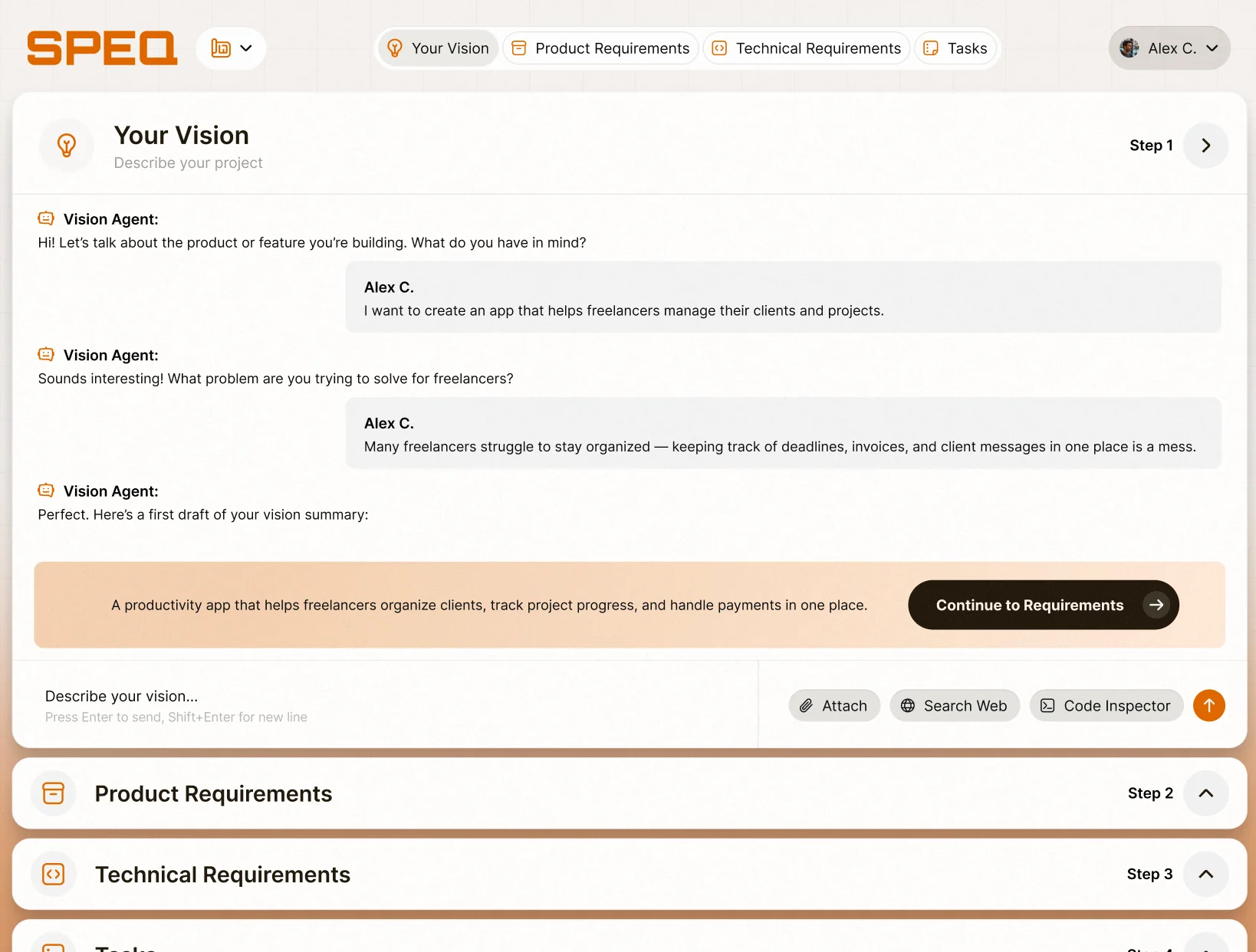
UNIQUE TO SPEQ: Our Vision Agent engages in a multi-turn conversation, asking clarifying questions and iterating until your vision reaches a quality threshold. AI actively scores clarity, completeness, and feasibility before allowing progression. This critical step is completely absent in competitor platforms.
AI generates comprehensive functional and non-functional requirements based on your refined vision, then grades them for completeness. Edit conversationally or click to modify individual items. Only when requirements meet quality standards can you proceed to technical specs.
Define architecture, tech stack, performance criteria, security requirements, and scalability considerations. AI evaluates technical completeness, identifying gaps in security, scalability, or architectural decisions before you move to implementation.
Automatically break down your complete, quality-validated specification into discrete, executable tasks. Tasks integrate directly with Jira and Asana for human implementation, or export step-by-step instructions to AI coding agents for automatic development—giving you the flexibility to choose your implementation approach.
SPEQ adapts to each stakeholder's role while maintaining a single source of truth.
In real product development, the same people wear different hats at different stages. SPEQ recognizes this—providing the right interface and guardrails for each phase, whether you're thinking strategically about business outcomes or diving deep into technical architecture.
Business Leaders • Founders • Executives
Focus on business outcomes, user problems, and strategic goals. SPEQ's conversational interface makes it easy for non-technical stakeholders to articulate vision without getting lost in implementation details.
Product Managers • UX Designers • Business Analysts
Define features, user flows, and experience requirements. Product and design teams collaborate to ensure requirements capture both functional needs and user experience goals.
Architects • Engineering Leads • DevOps
Define architecture, tech stack, security, scalability, and infrastructure needs. Engineering teams ensure technical feasibility and identify potential challenges before development begins.
Entire Team • Engineers • AI Agents
Tasks export to Jira/Asana for human developers OR to AI coding agents (Lovable, Claude Code) for automatic implementation. Each task includes step-by-step instructions that keep AI agents focused and productive.
From conversational vision refinement to structured specifications—all in a beautiful, accessible interface.
SPEQ's Vision Agent doesn't just take a prompt—it engages in a thoughtful dialogue. Watch as it asks clarifying questions, refines understanding, and validates the vision reaches quality thresholds before moving to requirements. This multi-turn conversation ensures everyone is aligned on WHAT to build before deciding HOW to build it.
SPEQ's clean, professional interface makes it perfect for teams of all sizes. The platform seamlessly handles projects of any scale—from startup MVPs to enterprise transformations—with a user experience that eliminates the learning curve typical of developer-focused tools.
Spec-Driven Development is exploding—backed by top VCs and tech giants investing hundreds of millions.
CLI platform raised $125M at $750M valuation from Index, Accel, and GV
SpecKit open-source SDD platform shows massive developer community interest
Amazon launched Kiro IDE—spec-driven development now has tech giant backing
Founded by: Guy Podjarny (Snyk founder)
Format: CLI/Terminal-based
Status: Pre-launch (early 2025)
Weakness: Inaccessible to non-technical users
Backed by: AWS/Amazon
Format: Desktop IDE (VS Code fork)
Status: Public preview
Weakness: Single-developer focus, no team collaboration
Type: Open source
Format: CLI-based
Community: 40K+ GitHub stars
Weakness: Requires technical expertise, no enterprise features
Solve the context window problem that's limiting AI coding effectiveness.
Modern AI coding agents have massive context windows—200K+ tokens that seem limitless. But there's a catch: as these windows fill with requirements, specifications, and code, the AI's effectiveness plummets.
Overwhelmed with everything at once → Lost focus → Poor quality output
SPEQ maintains the complete specification as a master plan, but exposes only one task at a time to AI coding agents. Each task includes step-by-step instructions that keep the agent focused on a single, achievable goal.
By feeding agents discrete tasks instead of entire specifications, their context windows stay lean and focused. This results in higher quality code, fewer bugs, and faster development—the agent isn't distracted by irrelevant details.
As specifications evolve, SPEQ updates the master plan and regenerates tasks. AI agents always work from the latest, most accurate instructions without context confusion from outdated requirements.
While other platforms dump entire requirement documents into AI agent context windows and hope for the best, SPEQ orchestrates a structured, sequential workflow that plays to AI's strengths. It's the difference between giving someone a phone book and asking them to find a number, versus giving them the exact page and line.
From code chaos to crystal-clear specifications—automatically.
Most companies have the opposite problem: they have massive existing codebases with little or no current documentation. Specifications were never written, or they're hopelessly outdated. Institutional knowledge lives only in the heads of senior engineers who might leave at any moment.
Point SPEQ at your existing codebase—whether it's a monolith or complex microservice architecture. Our AI analyzes the code, reverse-engineers the intent, and generates a complete specification capturing what the system actually does.
For enterprise systems with dozens or hundreds of microservices, SPEQ will map dependencies, document APIs, and create comprehensive specifications for each service—preserving critical architectural knowledge that's currently locked in code.
Once your existing system is documented in SPEQ, creating specifications for changes becomes trivial. The AI already understands your architecture, dependencies, and patterns—so it can rapidly generate validated specs for new features or modifications.
No more knowledge walking out the door when senior engineers leave. The system's true behavior is captured in living documentation.
New developers understand the system in hours instead of months. They have complete, accurate specifications instead of hunting through code and asking questions.
Want to migrate from microservices to monolith? Switch frameworks? With complete specifications, AI agents can rebuild the system with confidence—knowing exactly what behavior to preserve.
That 10-year-old codebase everyone's afraid to touch? It becomes manageable. SPEQ transforms undocumented legacy systems into well-specified, maintainable assets.
While competitors raised $125M+ to build CLI tools for developers, we're democratizing SDD for everyone.
Tessl and Kiro both require terminal expertise. SPEQ is accessible through any browser—no installation, no command-line knowledge required. This opens the market to product managers, founders, and enterprise stakeholders who are excluded by CLI-only competitors.
While competitors focus on individual developers, SPEQ enables real-time team collaboration on specifications. Product managers, engineers, and stakeholders work together before code is written—preventing costly misalignment downstream.
We connect the entire workflow: from specification to task management (Jira, Asana) to AI code generation (Lovable, Claude Code). SPEQ isn't just a spec tool—it's the orchestration layer for modern AI-assisted development.
Competitors are fighting for the developer-only market. SPEQ expands the addressable market 10x by making spec-driven development accessible to non-technical stakeholders, creating an entirely new category: collaborative, web-based SDD platforms.
Our founders bring decades of experience building high-scale consumer applications at the world's largest retailers.
Co-Founder • 16+ Years Experience
Former Director of Engineering at Walmart Global Tech, Dylan led mobile, web, and back-end development for the Item Page and User Generated Content experiences serving millions of daily users. Previously a lead software engineer at a neuroinformatics research institute, Dylan specializes in building scalable, high-performance solutions across full-stack environments.
Co-Founder • Former Apple Developer
Most recently Director of Engineering at Target leading native iOS and Android development for search experiences used by millions daily. Weston spent nearly a decade at Walmart Global Tech advancing from Staff Engineer to Senior Mobile Engineering Manager, and previously held iOS development positions at Apple and EMC. Known for delivering high-stakes projects on time with exceptional quality.
Combined experience building consumer applications that serve hundreds of millions of users at Fortune #1 (Walmart) and Fortune #8 (Target)
Start free and scale as your needs grow — from individual founders to enterprise teams.
SPEQ is democratizing spec-driven development. Join us in making comprehensive specifications accessible to every product team.
Get Early Access